

Cyber Readiness · Cyber Heat Map® family
Cyber Heat Map scores 100+ capabilities across 14 categories and 4 operational readiness levels, then benchmarks them against peer institutions. The result: a streamlined view of where you’re strong, where you’re exposed, and what to fund next.

Grounded in 200+ peer capability assessments, updated as new engagements complete
Cyber Heat Map answers the Cyber Readiness question, one of the Three Lenses of Cyber Resilience that organize everything we do.
The Methodology
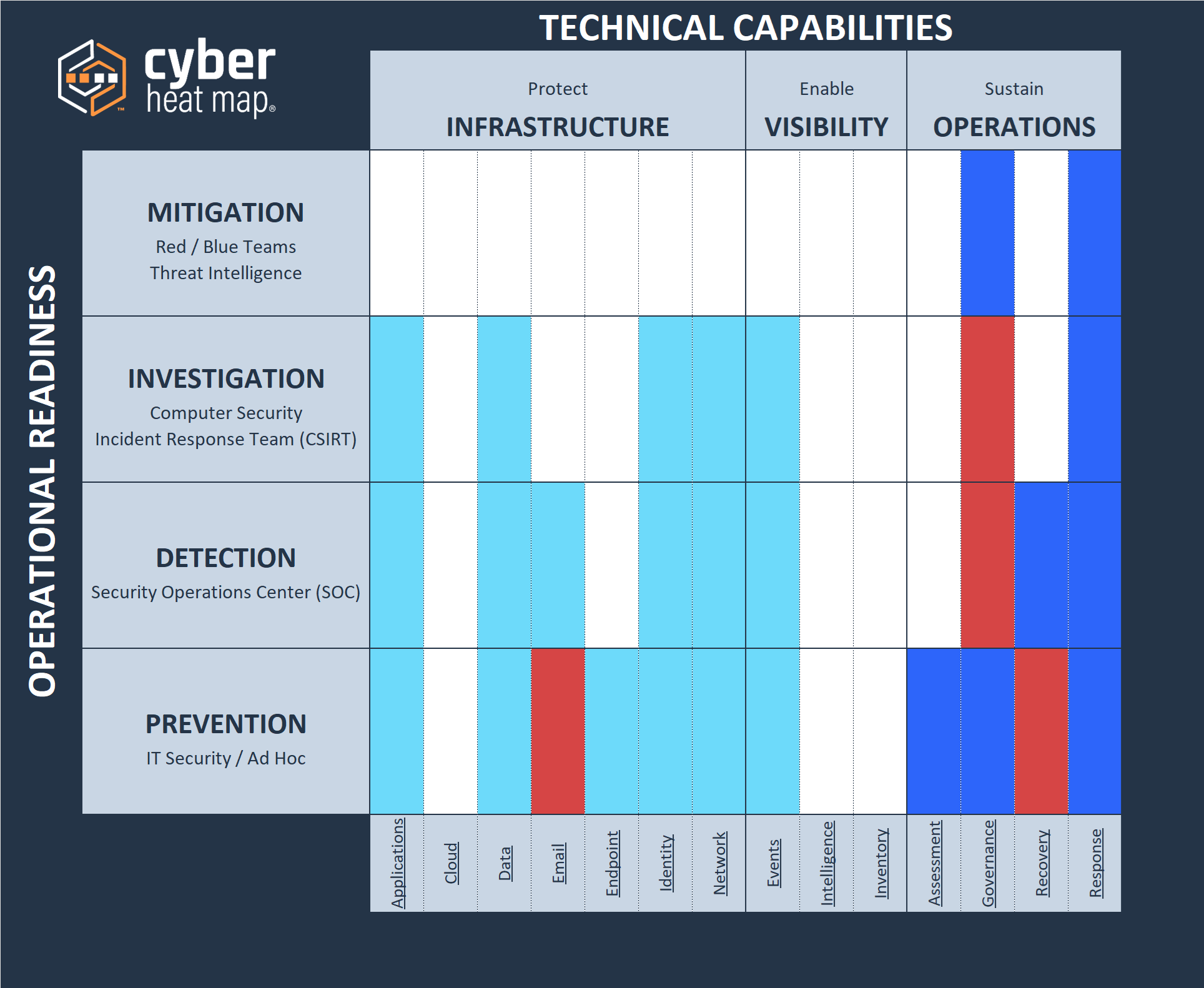
Each cell in the matrix represents one category at one readiness level. The color shows how robust your capability adoption is, creating a simple report of your entire cybersecurity portfolio that leaders can understand in 30 seconds.
The Cyber Heat Map® Matrix
Illustrative result
Columns
14 capability categories
Grouped into Infrastructure, Visibility, and Operations across the top of the matrix.
Rows
4 operational readiness levels
Prevention, Detection, Investigation, and Mitigation, lowest to highest, down the side.
Rollup
One 0 to 100 Diagnostic Score
Every cell is weighted and rolled up into a single score a board can read in seconds.
Operational Readiness
Rows: four levels, lowest to highest
01
Prevention
IT Security / Ad Hoc
Basic security measures in place, delivered by generalist IT staff rather than dedicated security operations.
02
Detection
Security Operations Center (SOC)
Dedicated monitoring capability that can identify threats as they occur.
03
Investigation
Computer Security Incident Response Team (CSIRT)
Structured capability to analyze, contain, and document security incidents.
04
Mitigation
Red / Blue Teams, Threat Intelligence
Advanced proactive and reactive capabilities that anticipate and reduce threats before they surface.
Technical Capabilities
Columns: 14 categories in three groupings
Infrastructure
Protect
Applications, Cloud, Data, Email, Endpoint, Identity, Network
Visibility
Enable
Events, Intelligence, Inventory
Operations
Sustain
Assessment, Governance, Recovery, Response
Institutions submit which solutions they have in place and at what deployment level. No tool access required.
Cyber Heat Map® family
Engage the Cyber Heat Map family at whatever layer fits your budget and maturity. The Diagnostic is the deliberate, low-risk entry point.
Layer 1
Free
Community Resources
Coming 2026
Cyber Heat Map Framework (CC BY-ND 4.0), including the self-assessment methodology. Will be published in late 2026.
Layer 2
$39
Books & Courses
Coming 2026
Cyber Heat Map practitioner guide teaching the methodology in depth. Planned following the framework publication.
Layer 3
$399
5 business days
Cyber Heat Map Diagnostic
Primary entry point
0 to 100 Diagnostic Score, a weighted rollup of your Cyber Heat Map Matrix
Peer benchmark against the higher education field
Solution portfolio analysis: coverage, gaps, and possible redundancy
Prioritized list of 3 to 5 capability gaps to address first
Personalized video overview of findings
30-day Cyber Bridge® coaching pass
$399 fee credits toward the Roadmap if you upgrade within 90 days
Layer 4
$4,999
10 business days
Cyber Heat Map Roadmap
Board-ready strategic roadmap built on Diagnostic findings
Solution portfolio review across your security stack
Prioritized recommendations with written narrative
Tier-level peer comparison against your CampusCISO Tier
30-minute strategy session to walk through the roadmap
Annual memberships bundle the Diagnostic and Roadmap layers with sustained advisory support and Cyber Bridge® small-group coaching. This helps you maintain momentum and track progress against your baseline.
Who it's for
Cyber Heat Map answers two things at once: where your capabilities stand today, and where the next dollar should go. It treats your security program as a portfolio to balance, not a checklist to complete.
For the CISO
Building the case for a tool or staffing investment, with evidence including peer adoption and rationale for priorities.
For the CIO
Needing a single read across the whole security stack, not fourteen separate conversations.
For a new security leader
Wanting a defensible baseline in the first quarter, and a clear picture of where the next dollar should go.
Capability isn't always the first question a CIO or CISO wants to answer. If audit and insurance readiness is the more urgent exposure, start with IT Policy. If the open question is whether your team can execute under pressure, start with TTX Coaching.
Questions
No. It used to be a SaaS application you logged into and self-scored. It's now a service: you submit your solution inventory, and we score it against the methodology and return the analysis. The legacy application retires in December 2026.
A solution inventory: the security tools and platforms you've deployed, and at what level. No tool access, no site visits, and no sensitive operational data. It's a list you already know.
An audit checks you against a fixed framework and tells you what's missing. Cyber Heat Map treats your capabilities as a portfolio, benchmarks them against how peer institutions actually operate, and shows you where the next dollar should go.
The founder reviews and validates every deliverable before it reaches you. AI handles the groundwork; expert judgment is the product. The Trust Anchor sets out how AI and your data are handled.
More than 200 peer capability assessments, updated continuously as new engagements complete. Because it's built from real assessments rather than public data, you're measured against how comparable institutions actually operate, not an idealized framework.

A scored picture of your cybersecurity capabilities in 5 business days. No site visits, no junior analysts, no open-ended billable hours.